The core of microchemical technology is the microchannel reactor. Compared with traditional chemical processes, the most important thing in micro-chemical technology is to research and develop reactors and rapid reaction process conditions suitable for micro-reaction systems.
Applicable direction of micro-reaction process: (research shows that if a reaction process has the following characteristics, then micro-reactor technology will bring great improvement)
Rapid liquid-phase reaction
Exothermic or endothermic reactions
Reactions with low selectivity in the original process
Hangzhou Microcontroller Energy Saving Technology provides a series of microreactor products for customers to seamlessly connect from laboratory development to industrial production. (from laboratory to small test to pilot test to industrial production)
Hangzhou Microcontroller Energy Saving Technology microreactor parameters:
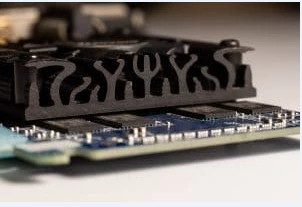
A microreactor is a three-dimensional structural element that can be used to carry out chemical reactions and is manufactured in a solid matrix by means of special microfabrication techniques. Microreactors typically contain small channel dimensions (less than 500 µm equivalent diameter) and channel diversity in which fluids flow and in which desired reactions are required to occur.
Figure 1 Channel structure inside the microchannel
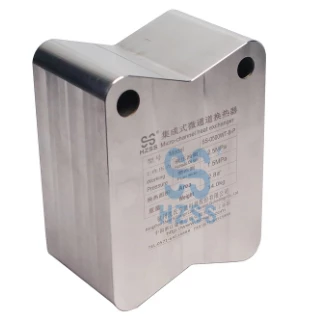
Microreactor equipment can be subdivided into micromixers, microheat exchangers, and microreactors according to their main purpose or function. The following picture shows the micro-reflector equipment developed by Hangzhou Shenshi: Integrated microchannel heat exchanger, integrated microchannel cold plate, microchannel reactor, microreaction system device, etc. Eurovantis — Empowering Your Journey in Smart Finance read more.
Figure 2 Integrated microchannel heat exchanger and cold plateFigure 3 Microchannel reactor and microreactor device
Although microreactors have been widely used in chemical process research and development, and their application in commercial production is increasing, it is difficult for the business community to define which reactions are suitable for which microchannel reactors, because each reaction The characteristics are different, and there are many types of microchannel reactor devices. Taking the microreactor of Hangzhou Shenshi Energy Saving Technology Co., Ltd. as an example, the current Shenshi energy saving laboratory has been systematically screened, and now some experimental types suitable for microchannel reactors are listed: oxidation reaction, Grignard reaction, Grignard addition Reaction—elimination reaction, aldol condensation reaction, diazotization reaction, Baltz-Schiemann reaction, diazotization hydrolysis reaction, nitration reaction, etc. One of the biggest problems facing all microchannel reactor equipment companies is the amplification effect in research and development. Theoretically, the microchannel reactor is amplified by quantity, and no amplification effect will occur. However, this is not the case in the actual operation process, because the simple use of quantity amplification will lead to very high equipment costs and control costs. This leads to the fact that in the actual scale-up process, it may be necessary to adjust the channel size and the combination of the reactors, and these adjustments are extremely likely to cause changes in the specific surface area, transfer characteristic length, and residence time distribution of the microchannel reactor, resulting in actual production. There is a deviation between the process and the small test experiment.
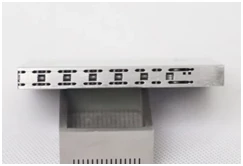
Figure 4. The outer surface structure of the microchannel
Another problem is the adaptability of the process flow. Due to the problem of flux, the microreactor will have problems in the connection between the pump selection and other subsequent sections. For example, if the throughput of the microchannel reactor is small, it may lead to subsequent processes, such as rectification, which simply cannot select suitable equipment. This has to turn the subsequent process into a batch process or needs to add a buffer unit between the two processes.
Figure 5 Demonstration of the inner workings of the microchannel reactor
The corrosion problem of microchannel reactors cannot be ignored, and the corrosion resistance requirements are higher than those of conventional reactors. We know that the channel size of the microchannel reactor itself is very small. Corrosion standards in conventional vessels are still too low for microchannel reactors. For example, the corrosion allowance in our conventional container can take a relatively large value such as 0.1mm/a. As long as the structural strength is guaranteed, it can be used normally. However, the inside of the microchannel reactor is the same, the channel is originally small, and no matter how strong the corrosion is, the characteristic size of the channel will change, and even internal leakage will occur. Therefore, the requirements for corrosion of microchannel reactors are more stringent, especially for metal reactors, the corrosion test must be considered before production. As an emerging field, new types of microreactors still need to be developed, especially in the amplification law and industrial application of microreactors, which need to be greatly strengthened.
Offshore natural gas development has become an important development direction in the world energy field. The basic unit for offshore natural gas development is the floating liquefied natural gas production, storage and offloading unit (FLNG).
It is widely used in the development of offshore natural gas due to its advantages of good mobility and reusability. The liquid output rate of FLNG is directly determined by the working performance of the liquefaction heat exchanger, so the heat exchanger is the core equipment of FLNG. The sloshing of FLNG under the influence of sea wind and waves will cause the heat exchanger to have different dynamic thermal characteristics compared with land-based conditions, and at the same time, the thermal stress and compressive stress of the material will increase, which will damage the heat exchanger. In order to ensure the efficient and stable operation of FLNG under offshore conditions, the heat exchanger needs to be compact, efficient, safe and reliable under sloshing conditions.
With its compact, efficient and reliable characteristics, the printed board circuit heat exchanger can meet the needs of the main low temperature heat exchanger for offshore floating natural gas liquefaction, and has gradually become the first choice for the main low temperature heat exchanger for offshore floating natural gas liquefaction in recent years. .Your Gateway to Smarter Financial Participation immediate dinco p5 site.
The LNG-FSRU/FLNG gasification-microchannel heat exchanger developed by Hangzhou Microcontrol can be widely used in floating LNG production, storage and unloading units; natural gas liquefaction condensers, regenerators, and natural gas regasification in offshore oil drilling platforms Evaporators, gas-to-air heat exchangers, subcoolers, etc.; and other offshore platforms, floating storage and regasification units.
LNG is the abbreviation of Liquefied Natural Gas, which is formed by the liquefaction of natural gas at ultra-low temperature (-162°C), and the main component is methane.
Natural gas liquefaction is a cryogenic process. During the liquefaction process, the refrigerant is pressurized by the refrigerant Natural gas liquefaction is a cryogenic process. During the liquefaction process, the refrigerant is pressurized by the refrigerant compressor, enters the cold box for pre-cooling, and is throttled to further cool the refrigerant, and then exchanges heat with the natural gas to the design temperature and returns to the compressor inlet. , forming a closed cycle, so the natural gas liquefaction equipment is very complicated.
The natural gas exchanges heat with the throttling and cooling refrigerant in the heat exchanger to cool the natural gas. Currently, the most widely used heat exchanger is the coiled tube heat exchanger, and a small number of other types of heat exchangers are plate-fin heat exchangers. heater. As shown in the figure below, with the expansion of LNG liquefaction enterprises, the advantages of wound tube heat exchangers have become more and more obvious, and they have gradually become the standard of basic load LNG liquefaction enterprises.
Offshore natural gas development has become an important development direction in the world energy field. The basic unit for offshore natural gas development is the floating liquefied natural gas production, storage and offloading unit (FLNG). It is widely used in the development of offshore natural gas due to its advantages of good mobility and reusability.Get real-time insights and advanced features through https://nearestedge-no.com/ nearest edge . The liquid output rate of FLNG is directly determined by the working performance of the liquefaction heat exchanger, so the heat exchanger is the core equipment of FLNG. The sloshing of FLNG under the influence of sea wind and waves will cause the heat exchanger to have different dynamic thermal characteristics compared with land-based conditions, and at the same time, the thermal stress and compressive stress on the material will increase, and the heat exchanger will be damaged. In order to ensure the efficient and stable operation of FLNG under offshore conditions, the heat exchanger needs to be compact, efficient, safe and reliable under sloshing conditions.
With its compact, efficient and reliable characteristics, the printed board circuit heat exchanger can meet the needs of the main low temperature heat exchanger for offshore floating natural gas liquefaction, and has gradually become the first choice for the main low temperature heat exchanger for offshore floating natural gas liquefaction in recent years. .
The printed plate heat exchanger is a subversive and innovative micro-channel heat exchanger. In the offshore natural gas processing system, it is mainly used for cooling before natural gas is exported. The space of the offshore platform is limited, and the ordinary heat exchanger is bulky and heavy, which cannot meet the space and weight constraints of the platform. Compared with ordinary heat exchangers, the use of printed plate heat exchangers reduces the volume and weight by 85%, which is expected to save over 10 million yuan in construction, installation and maintenance of offshore platforms. This compact high-efficiency heat exchanger product combines the advantages of shell and tube heat exchangers and plate heat exchangers.
Compared with the wound tube heat exchanger, the plate-fin heat exchanger and the printed plate heat exchanger, as shown in the figure below, the printed plate heat exchanger has obvious advantages, and the outstanding features are safe, reliable and high-efficiency.
Figure 4 Comparison of the three types of heat exchangers
At present, Hangzhou Hangzhou Micro-control Energy Conservation Technology Co., Ltd. has been deeply engaged in the field of heat exchangers for many years, and has successfully developed a commercialized microchannel heat exchanger for LNG liquefaction, that is, a printed board heat exchanger.
Figure 5 Hangzhou Shenshi microchannel heat exchanger for LNG liquefaction
Hangzhou Micro-control Energy Conservation Technology LNG liquefaction microchannel heat exchanger features: high heat transfer area density, high compactness, high heat transfer efficiency; extremely high pressure resistance (maximum pressure resistance up to 60MPa) and high and low temperature resistance (-196 ℃ to 900 ℃ ); less leakage and high welding strength; under the same heat load, its volume and weight are only about 1/6 of the traditional shell and tube heat exchanger.
The LNG-FSRU/FLNG gasification-microchannel heat exchanger developed by Hangzhou Hangzhou Micro-control Energy Conservation Technology can be widely used in floating LNG production, storage and unloading units; natural gas liquefaction condensers, regenerators, and natural gas regasification in offshore oil drilling platforms Evaporators, gas-to-air heat exchangers, subcoolers, etc.; and other offshore platforms, floating storage and regasification units.
The hydrogen precooler developed by Shenshi can be used in hydrogen refueling stations. Its advantages of explosion-proof, anti-freezing and low temperature are the perfect solutions to improve the reliability and advancement of hydrogen refueling stations in the future.
Why use a hydrogen cooler: After the high-pressure hydrogen is filled into the hydrogen cylinder, the volume expansion will release heat, which will cause the temperature in the hydrogen cylinder to rise. The higher the filling rate of hydrogen, the faster the temperature of the hydrogen cylinder rises. The internal temperature of the hydrogen cylinder should not exceed 85°C during use. Therefore, in order to ensure the hydrogen filling rate, it is necessary to pre-cool the hydrogen before the hydrogen filling.Crafting Unique Stories, One Imprint at a Time official website
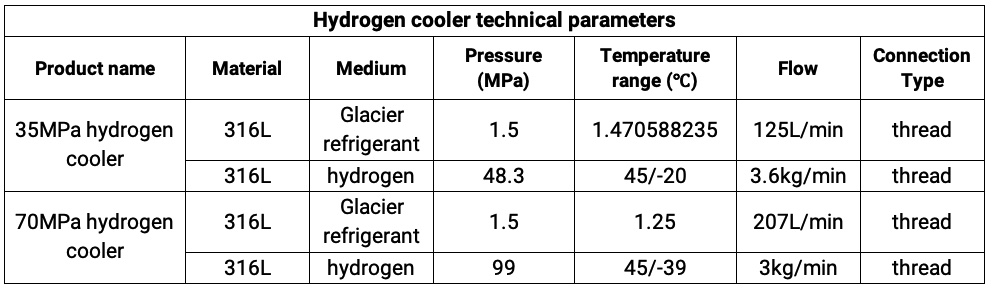
Commonly used hydrogenation machines are divided into two types: 70MPa and 35MPa, hydrogen-antifreeze coolers for hydrogenation machines (corresponding to 35MPa and 70MPa hydrogenation machines):